
Official Rules & Detective’s Dossier
Complete Official Rules, Visual Pattern Diagrams, Engine Examples & Official Rulings • 2–4 Players • 30–45 Mins • Ages 14+
Game Overview & The 108-Card Deck
Three Classic Conan Doyle Cases • One Competitive Investigation Engine
In Deductions: The Sherlock Holmes Board Game in a Deck, 2 to 4 players compete as rival consulting detectives in Victorian London. Across a single deck of 108 poker-sized cards, you will investigate three iconic mysteries by Sir Arthur Conan Doyle: The Hound of the Baskervilles, The Sign of the Four, and The Adventure of the Speckled Band. Gather Clues from a shared 4×4 Clue Grid, solve Case Cards to earn Victory Points, and flip every solved Case to its reverse Asset Side to build a permanent investigative engine. The first detective to reach 15+ Points triggers the final round!
15 Solutions & 30 Red Herrings
- • 15 Solution Cards (Solid Black Borders): High-cost true elements worth 2 to 4 Points.
- • 30 Red Herring Cards (Clean White Borders): Low-cost false leads worth 0 to 1 Point that rapidly build your Asset engine and Milestone sets.
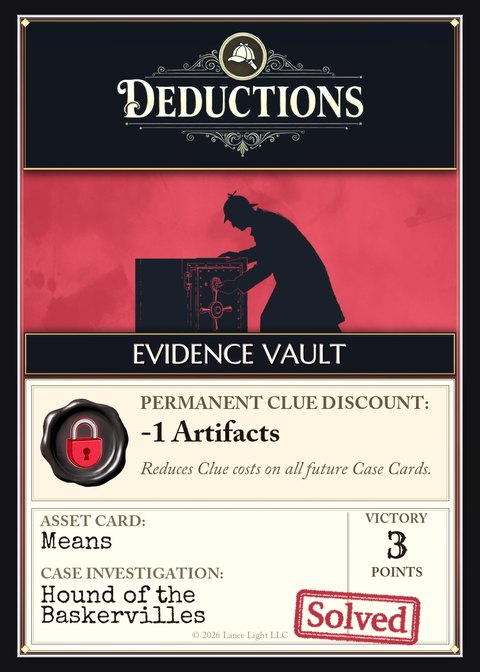
- • Reverse Asset Side: Every solved Case flips over to grant a permanent –1 Clue Discount.
55 Regular Clues + 5 Allies
- • 11 Regular Clues per Suit: Think of each Clue type as a sort of currency spent from your public Clue Pool to pay Case Card costs.
- • 5 Special Character Allies (1 per Suit): Sherlock Holmes, Inspector Lestrade, Dr. Watson, Mycroft Holmes, and Irene Adler.
- • Wild Card Back: All 60 Clue Cards share the magnifying-glass Wild Card back used for grid pattern props.
6-Page Quick Reference
- • Ref Card 1: Primary & Complex 4×4 Grid Investigation Patterns + Wild Card Rule.
- • Ref Card 2: Turn Action 1 (Obtain Clues) & Turn Action 2 (Solve a Case).
- • Ref Card 3: Scoring, 15-Point Trigger, Tiebreakers & Milestone Bonus Matrix.
The 5 Evidence Suits & Corresponding Case Categories





Game Setup (5 Steps)
Preparing the 4×2 Case Display & 4×4 Clue Investigation Grid
Separate the 45 Case Cards into 15 Solutions (Black Borders) and 30 Red Herrings (White Borders). Shuffle each pile separately with their Case Front (cost side) face-up:
- Top Row (4 Solutions): Place the face-up Solution draw pile in Slot 1, then deal 3 Solutions beside it (4 visible Solutions total).
- Bottom Row (4 Red Herrings): Place the face-up Red Herring draw pile in Slot 1, then deal 3 Red Herrings beside it (4 visible Red Herrings total).
- All 8 visible cards (including the top card of both draw piles!) are open to be solved.
Shuffle all 60 Clue Cards (including the 5 Special Character Allies) face-down and deal 16 cards face-up in a 4×4 grid in the center of the table.
Place the remaining 44 Clue Cards face-down beside the grid as the Clue Deck (showing the Wild Card back). Leave space next to it for a face-up Discard Pile.
4. Detective Pools: Every detective starts with 0 Clue Cards and 0 Assets (kept face-up in your public area; max 10 Clues at end of turn). 5. First Detective: Selected by mutual agreement, random draw, or whoever most recently read a mystery story!
On Your Turn — Option 1: Obtain Clues (+2 Clues Total)
On your turn, perform EITHER Option 1 (Obtain Clues) OR Option 2 (Solve a Case)
When you choose Obtain Clues on your turn, you always gain exactly 2 Clue Cards into your public pool by performing Step 1 followed by Step 2 (Option A or Option B):
Draw 1 Clue from Deck
Draw the top card of the Clue Deck and place it face-up into your public Clue Pool. This is your 1st Clue of the turn (and you may also use its Wild Card back as a temporary prop in Step 2A!).
Investigate the 4×4 Grid
Identify any valid 4-card geometric pattern of the same Clue type on the 4×4 grid. Take 1 face-up matching card from that pattern into your pool (your 2nd Clue), then deal 1 fresh card from the Clue Deck to refill that single vacant slot!
Retreat to Mind Palace
Mandatory if no valid pattern exists; optional anytime! Choose any 1 full Row or Column (4 cards). Take all 4 cards, shuffle them face-down, blindly draw 1 at random into your pool (your 2nd Clue), discard the other 3 face-up, and deal 4 fresh cards from the Clue Deck to refill the line.
🔍 How Hovering the Face-Down "Wild Card Prop" Works
If 3 cards on the grid almost form a valid 4-card pattern (3 matching Clues + 1 mismatch), you may hover any Clue card from your pool (such as the card you just drew in Step 1) face-down over the 4th mismatched slot so its "Wild Card" back completes the 4-card shape!
Crucial Rule: The mismatched card underneath your hovered Wild Prop is not taken, staying in the grid. You may only take 1 of the 3 face-up matching Clue cards into your pool, and return your hovered prop card right back to your pool. Refill only the 1 vacant slot!
⚖️ 10-Card Clue Pool Limit (Checked at End of Turn)
A detective may hold a maximum of 10 Clue Cards in their public Clue Pool at the end of their turn.
If you ever have more than 10 Clue Cards at the end of your turn, immediately discard excess Clues of your choice face-up down to 10.
Note: Solved Asset Cards and a privately reserved Case Card (via Mycroft Holmes) do NOT count toward your 10-Clue limit!
All 8 Valid 4-Card Investigation Patterns
Any rotation or mirror reflection on the 4×4 Clue Grid is valid
Full Row
Any complete horizontal row of 4 matching Clue cards across the 4×4 grid.
Full Column
Any complete vertical column of 4 matching Clue cards down the 4×4 grid.
Diagonal
Either of the two main 4-card diagonals connecting opposite corners of the grid.
2×2 Block
Any 2×2 square block of 4 touching cards anywhere inside the 4×4 grid.
Four Corners
The 4 outermost corner positions of the 4×4 Clue Grid.
Diamond
Any 4 cells forming a hollow diamond around a single center space.
Tetromino L
3 cards in a line plus 1 card at either end at a 90° angle (any rotation or reflection).
Tetromino T
3 cards in a line plus 1 card attached to the middle card (any rotation).
On Your Turn — Option 2: Solve a Case Card
Crack a visible (or reserved) Case, claim its Victory Points, and flip it into a Permanent Asset
Select Target Case
Choose any 1 of the 8 visible Case Cards in the 4×2 Case Display (including the top card of either draw pile) OR a Case Card you previously reserved using Mycroft Holmes.
Apply Asset Discounts
Each solved Asset Card in your agency permanently reduces its matching Clue requirement by –1 (to a minimum of 0). If your Assets reduce every requirement to 0, you solve the Case for 0 Clues!
Spend Clues & 3:1 Wilds
Think of a Clue type as a sort of currency: discard matching Clues from your pool to pay the remaining symbols on the Case’s bottom bar. Cross-Reference (3-for-1): Spend any 3 Clue cards from your pool as 1 Clue of any type! (Solved Asset discounts are never involved in 3-for-1 trades.)
Flip to Asset & Refill
Flip the solved Case Card to its reverse Asset Side and place it face-up in your agency. Score its printed points, check Milestone Bonuses, and immediately refill the empty Case Display slot!
The 5 Special Character Allies
1 Unique Character Card per Suit in the 60-Card Clue Deck
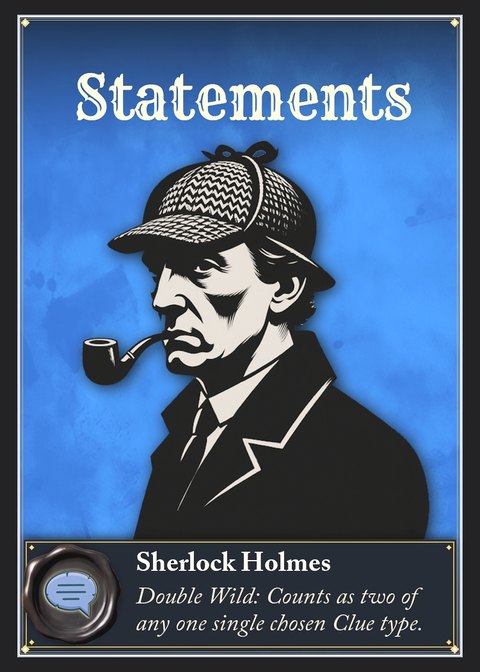
Sherlock Holmes
Statements When Spent to SolveWhen spent from your pool to help solve a Case Card, Sherlock counts as TWO Clues of any ONE single chosen Clue type (e.g., 2 Statements, 2 Artifacts, or 2 Knowledge).
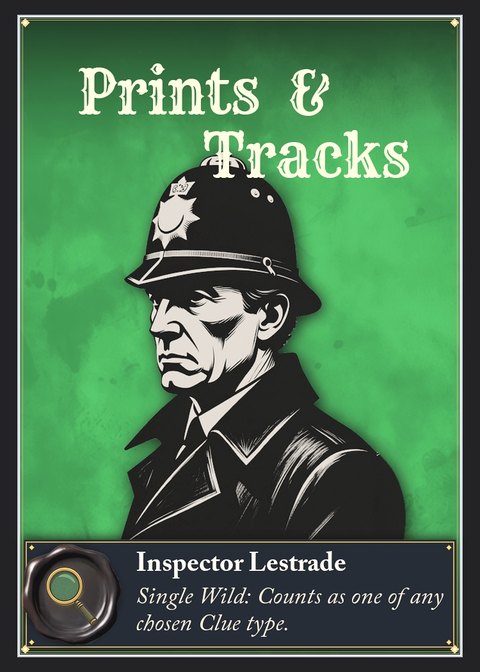
Inspector Lestrade
Prints & Tracks When Spent to SolveWhen spent from your pool to solve a Case Card, Lestrade counts as ONE Clue of ANY chosen Clue type.
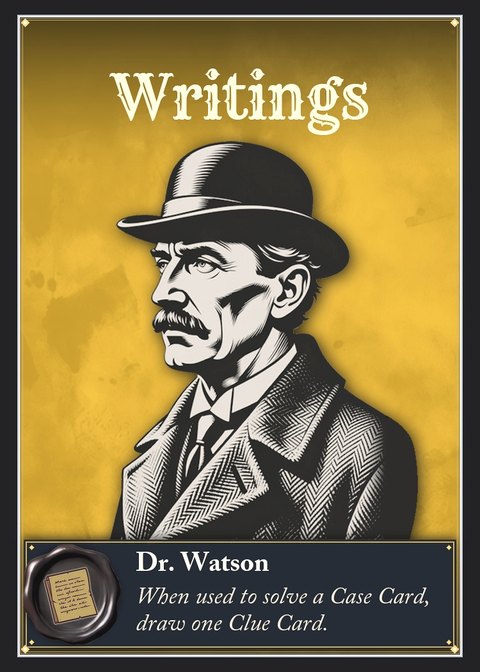
Dr. John Watson
Writings When Spent to SolveCounts as 1 Writings Clue (or 1 card in a 3-for-1 Cross-Reference). Immediately upon spending Watson to solve a Case, draw 1 replacement Clue from the Clue Deck into your pool.
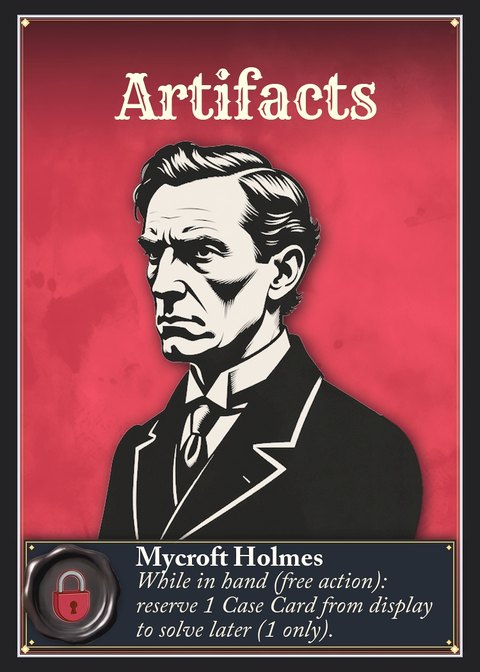
Mycroft Holmes
Artifacts Free Action in Pool (or Spend as 1 Clue)Once per possession while Mycroft is in your pool, take any 1 visible Case Card from the 4×2 Display (and refill its slot) to hold privately in your area. Only you may solve it later. Max 1 reserved Case at a time.
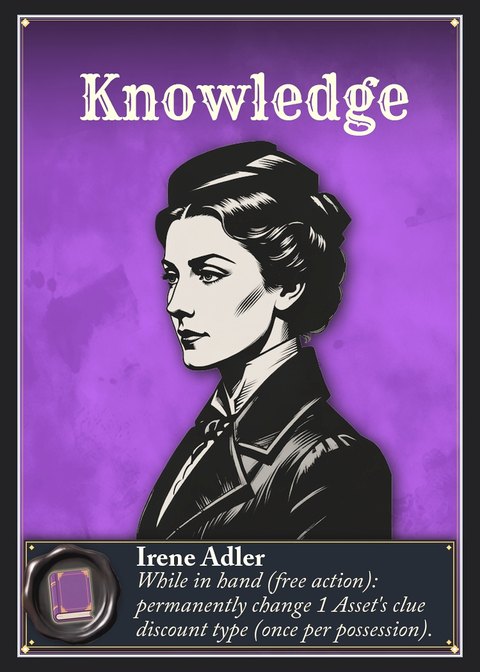
Irene Adler
Knowledge Free Action in Pool (or Spend as 1 Clue)Once per possession while Irene is in your pool, permanently change the discounted Clue type of 1 solved Asset Card you control to any Clue type of your choice (rotate 90° to mark). Does not change its category for bonuses.
Milestone Bonuses & The 15-Point Endgame Trigger
Set-Collection Bonuses (+3 Pts Each) • Non-Exclusive • No Crossover Rule
Category Diversity Bonus
Solve at least 1 Case Card from each of the 5 Categories (1 Suspect, 1 Location, 1 Motive, 1 Means, and 1 Opportunity). The cards may come from any mix of the three Cases, and both Solutions and Red Herrings count equally!
Case Completion Bonus
Solve any 5 Case Cards belonging to the same Case (e.g., any 5 cards from The Hound of the Baskervilles, or 5 from The Sign of the Four, or 5 from The Speckled Band). Categories may repeat, and both Solutions and Red Herrings count equally!
1. No-Crossover Rule (10 Cards for Both)
A single solved Case Card may only be committed to one Milestone Bonus. Claiming one bonus takes 5 solved cards; claiming both (+6 Pts) requires 10 distinct solved Case Cards (5 committed to Diversity + 5 separate cards committed to Case Completion). Every player may earn each bonus once (not first-come, first-served).
2. 15+ Points Triggers Final Round
As soon as any detective reaches 15 or more Total Points (Solved Case Points + Milestone Bonuses) at the end of their turn, the endgame triggers! Every other player gets 1 final turn, then all players tally their scores.
3. Official Tiebreakers
- Most Solution Cards (Black Borders) solved.
- Most total Asset Cards owned.
- Most Clue Cards remaining in pool.
Illustrated Step-by-Step Gameplay Examples
How Discounts, Allies, and 3-for-1 Cross-References Combine on a Real Turn
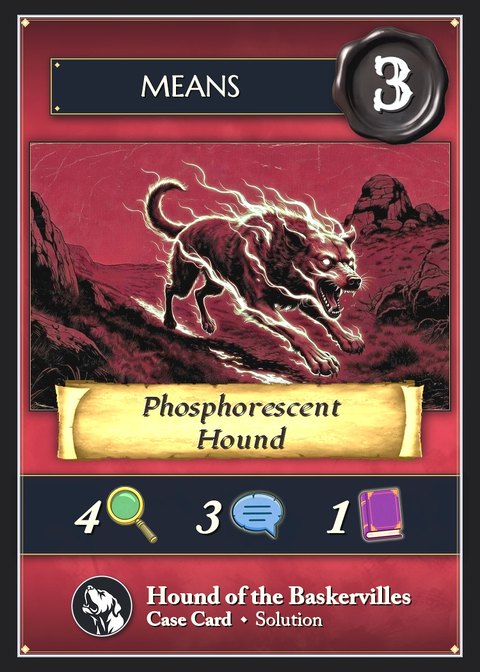
Cracking “Phosphorescent Hound” (8-Clue Solution Worth 3 Points)
Official FAQ & Edge-Case Rulings
Clarifications for Tournament & Tabletop Play